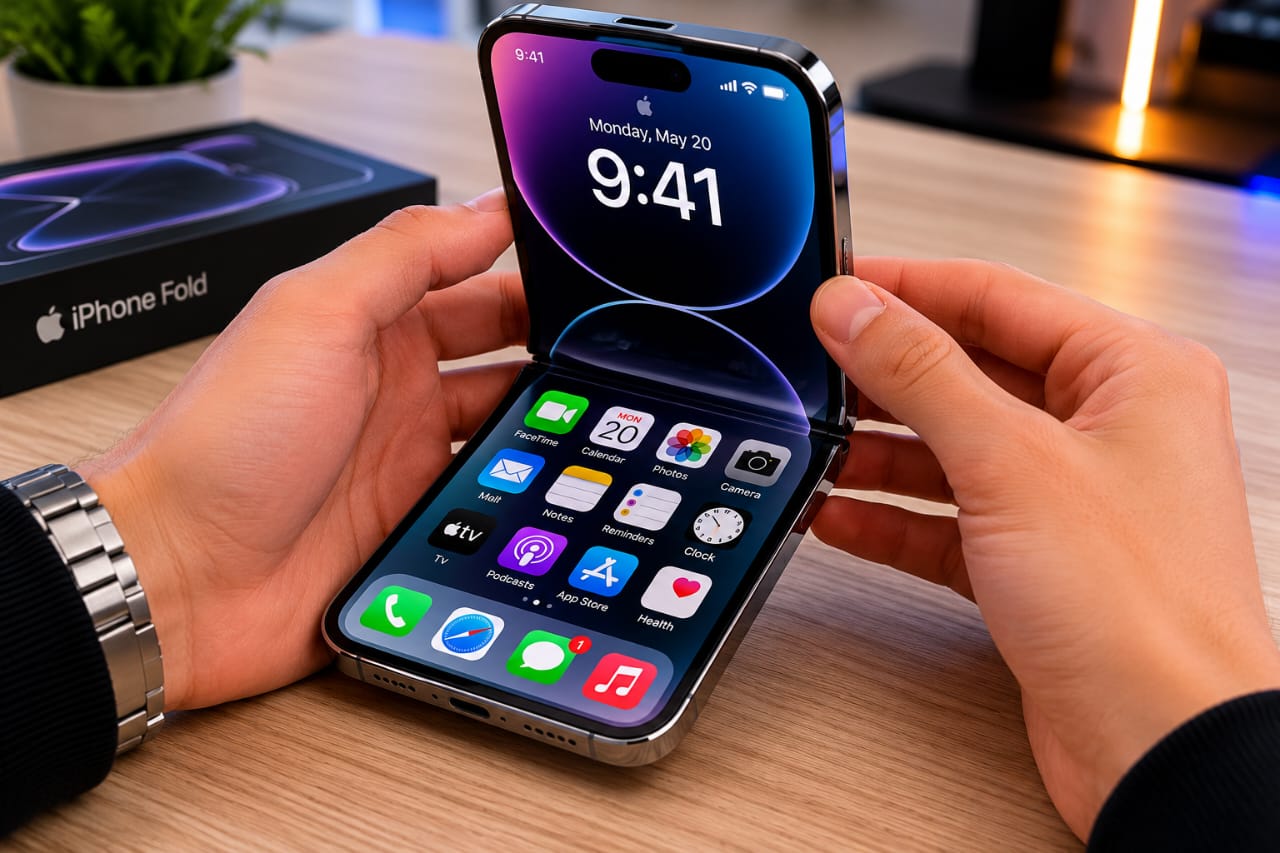
Apple September 2026 Event: What Nigerian Buyers Need to Know — iPhones, Foldable & Prices

Every September, Apple takes the stage and the internet goes into a frenzy. This year promises to be one of the biggest yet — and if you’re a tech-savvy Nigerian, here’s everything you need to know about what Apple is expected to announce and what it could mean for your pocket.

When is the Apple September 2026 Event?

Apple has not officially confirmed the date yet, but based on their consistent annual calendar, the September 2026 iPhone event is widely expected to fall in the week of September 7 — possibly September 8 or 9. Apple keynotes typically begin at 10:00 AM Pacific Time, which translates to 6:00 PM Nigerian time (WAT). Mark your calendar.

What Apple is Expected to Announce

📱 iPhone 18 Pro — the camera upgrade you’ve been waiting for

The iPhone 18 Pro is shaping up to be a serious camera beast. Rumours point to a variable aperture main lens — similar to how a DSLR camera works — giving you more control over depth of field and low-light shots. It will reportedly run Apple’s new A20 Pro chip, built on a 2nm process, making it faster and more efficient than any iPhone before it. A smaller Dynamic Island and a rumoured dark cherry colour option round things out.

📲 The foldable iPhone — Apple finally goes foldable

This is the headline announcement everyone has been waiting for. Apple is reportedly launching its first-ever foldable iPhone, rumoured to be called the “iPhone Fold” or “iPhone Ultra.” Here’s what makes it exciting:

  • A 5.3-inch external screen that unfolds into a 7.6-inch internal display
  • Book-style fold design — think a small iPad mini when open
  • Just 4.5mm thin when unfolded — incredibly slim
  • Advanced hinge tech designed to nearly eliminate the crease

⌚ Apple Watch Series 12 & more

Alongside the iPhones, a new Apple Watch Series 12 is expected. There are also rumours of updated HomePod and Apple TV models, and potentially iPad and iPad mini refreshes.

What Does This Mean for Nigerian Buyers?

💸 Brace for the Naira price

Here’s the honest truth: buying Apple products in Nigeria has never been cheap, and 2026 is unlikely to be different. With the Naira still under pressure against the dollar, expect prices at authorised Nigerian retailers like iStore, Slot, and 3CHub to reflect the exchange rate at time of import.

As a rough guide — if the iPhone 18 Pro starts at $999 in the US, you could be looking at somewhere in the region of ₦1.6 million to ₦1.9 million or more, depending on exchange rates and import duties at the time of Nigerian launch. The foldable iPhone will likely start at a premium above that — possibly $1,499 or more in the US, translating to well over ₦2 million locally.

🛍️ Grey market vs. authorised retail

Many Nigerians purchase iPhones through the grey market — buyers bringing devices from the UK, US, or Dubai. This often makes phones cheaper but comes with no official warranty. If you want to be among the first to get the new iPhones in Nigeria, start saving now and decide whether you’ll go official retail or grey market.

🌍 Is the foldable iPhone worth it for Nigeria?

Probably not as a day-one purchase. Foldable phones are still a relatively new category, and the price premium is massive. However, if you’re a content creator, business person, or power user who could genuinely benefit from a large screen in your pocket, it’s worth keeping an eye on reviews before deciding.

How to Watch the Apple Event Live from Nigeria

You can stream the September event live at 6:00 PM WAT on:

We’ll be covering the event live on this blog — bookmark this page and follow us for real-time updates and a Nigerian buyer’s breakdown of everything Apple announces.


Are you planning to upgrade to iPhone 18 or waiting to see the foldable? Drop your thoughts in the comments below!

Sources: Apple Newsroom | Apple Events | MacRumors | Macworld

Xiaomi Devices Can Now Use AirDrop: Everything You Need to Know

Introduction

If you own a Xiaomi smartphone, here is some exciting news: you can now share files directly with iPhone, iPad, and Mac users using Apple’s AirDrop; no third party apps, no cables, no complicated steps required. Xiaomi has officially joined a growing list of Android manufacturers bringing this game changing feature to their devices; and it is only getting started.

In this article, we break down exactly what this means, which devices are supported, and why this is such a big deal for everyday smartphone users.


What Is AirDrop and Why Does It Matter?

AirDrop is Apple’s wireless file sharing feature that allows iPhone, iPad, and Mac users to send photos, videos, documents, and more to each other instantly. It is fast; it is seamless; and it has always been one of the features Android users wished they had access to.

For years, sharing files between an Android phone and an iPhone meant relying on third party apps like WhatsApp, Google Drive, or Bluetooth workarounds. That frustration is now becoming a thing of the past.


How Did This All Begin?

The story starts in November 2025, when Google made a landmark announcement: Android’s Quick Share would now work seamlessly with Apple’s AirDrop. At the time, the feature was exclusive to the Google Pixel 10 series. However, Google always intended to expand it further.

By early 2026, the feature had already reached the Pixel 9, Pixel 10a, and Samsung Galaxy S26 series. Then on May 12, 2026, Google officially confirmed that AirDrop support via Quick Share would expand to several major Android partners; including Samsung, OPPO, OnePlus, Vivo, Xiaomi, and Honor throughout 2026.


Xiaomi Joins the Party

Xiaomi became the latest Android brand to announce AirDrop support, following similar announcements from Samsung, Vivo, and OPPO. The company shared a video preview of the feature through its official Xiaomi HyperOS account on X (formerly Twitter), showing just how smoothly the file sharing works between a Xiaomi device and an Apple device.

The feature is part of a new HyperOS 3 update; which is Xiaomi’s custom version of Android 16. Currently, the Xiaomi 17T Pro is the first confirmed device to receive the update. However, other HyperOS 3 devices are expected to follow in the coming weeks.

With the update, Xiaomi users can now; share images directly to iPhones via AirDrop; send documents and files to MacBooks wirelessly; and receive files from Apple devices right in the standard Quick Share menu. All of this happens within the existing HyperOS sharing interface; making it feel completely native.


Which Xiaomi Devices Will Get It?

At the moment, Xiaomi has officially confirmed support for the Xiaomi 17T Pro. The company has not yet released a full list of supported devices; though it is widely expected that other flagship HyperOS 3 devices will also receive the update soon.

Xiaomi is set to launch the Xiaomi 17T in India on June 4, 2026; and many are watching closely to see whether that device will also ship with AirDrop support out of the box.

For now, the feature is expected to roll out to high end Xiaomi models first; including the Xiaomi 17, Xiaomi 17T Ultra, and Xiaomi 17T. Budget and mid range models may have to wait longer; or may not receive the feature at all.


What Does This Mean for You?

If you own a supported Xiaomi device, this update means you no longer need any extra app to send a file to your friend’s iPhone. You simply open Quick Share on your Xiaomi phone; your friend opens AirDrop on their iPhone; and the transfer happens in seconds. Clean, fast, and effortless.

For Xiaomi users who work or study alongside iPhone users (which is most of us), this removes one of the most common daily frustrations in tech. It is a small update on the surface; but in practice it makes a significant difference.


What About Other Android Brands?

Xiaomi is not alone in this rollout. Here is a quick look at where things stand across major brands:

Google Pixel 10, 9, and 8a already support the feature. Samsung Galaxy S26; S25; S24; Z Flip 6 and 7; and Z Fold 6 and 7 are all confirmed. OPPO Find X9 series including the X9, X9s, X9 Pro, and X9 Ultra are supported. Vivo X300 Ultra is also confirmed. OnePlus and Honor are expected to follow; though specific device lists have not yet been released.


Final Thoughts

The wall between Android and iOS is slowly coming down; and Xiaomi’s latest update is proof of that. Whether you are a student sharing notes between devices, a professional sending files across platforms, or simply tired of the Android to iPhone sharing headache; this update is for you.

At EduTechHub, we will keep you updated as more Xiaomi devices receive this feature and as the rollout expands to other brands. Subscribe to our YouTube channel for video tutorials and the latest tech news explained simply.

Your AI advantage starts here.


Apple’s WWDC26 is here — everything you need to know about the June 8 keynote

Category: Devices & How-Tos
Estimated reading time: 5 minutes


Apple has officially announced the full schedule for its 2026 Worldwide Developers Conference — better known as WWDC26 — and the tech world is already buzzing. If you follow Apple products, use an iPhone, iPad, or Mac, or are simply curious about where technology is heading, this is one event you’ll want to keep an eye on.

Here is everything you need to know.


What is WWDC?

WWDC stands for Worldwide Developers Conference. It is Apple’s annual event where the company gathers developers from around the world to unveil the latest updates coming to its software platforms — iOS, macOS, iPadOS, watchOS, tvOS, and visionOS.

Think of it as Apple’s biggest software reveal of the year. Whatever Apple announces at WWDC will land on your iPhone and other Apple devices later in the year, typically in September alongside the new iPhone launch.


When is WWDC26?

WWDC26 runs from Monday, June 8 to Friday, June 12, 2026.

The opening keynote — where Apple makes its biggest announcements — kicks off on June 8 at 10:00 a.m. Pacific Time (that is 6:00 p.m. Nigerian time, WAT).

Shortly after, at 1:00 p.m. PT (9:00 p.m. WAT), Apple will hold the Platforms State of the Union — a more technical session aimed at developers, going deeper into the new features, APIs, and tools announced during the keynote.


How to watch it

You do not need to be a developer or travel to the United States to watch WWDC26. Apple is streaming the keynote live and for free through:

  • Apple’s website — apple.com
  • The Apple TV app — available on iPhone, iPad, Mac, and Apple TV
  • Apple’s YouTube channel — search “Apple” on YouTube

On-demand playback will be available immediately after the live stream ends, so you can watch at your convenience even if you miss the live broadcast.


What is happening during the week?

Beyond the opening keynote, WWDC26 has a packed schedule for developers and tech enthusiasts:

  • Over 100 video sessions covering new tools, technologies, and design — available online for Apple Developer members from June 8 to June 12
  • Group Labs — interactive online sessions where developers can work through new features with guidance
  • Q&A sessions with Apple engineers and designers — running daily from June 9 to June 12, available through the Apple Developer Forums and livestreams on the Apple Developer portal
  • In-person experience at Apple Park — more than 1,000 selected developers, designers, and students will attend in person at Apple’s headquarters in Cupertino, California

All WWDC26 content will also be accessible through the Apple Developer app, the Apple Developer website, and on YouTube, LinkedIn, WeChat, and bilibili.


What is Apple expected to announce?

Apple has not officially revealed what is coming, but based on industry reports and leaks from reliable sources, here is what to expect:

A brand new Siri

This is the biggest expected announcement of WWDC26. Apple is widely reported to be unveiling a completely redesigned Siri — internally codenamed “Campos” — that transforms the voice assistant into a much more capable AI chatbot.

The new Siri is expected to:

  • Be available as a dedicated standalone app for the first time
  • Feature a new interface integrated into the Dynamic Island on iPhone, with a glowing “Search or Ask” prompt
  • Support natural, multi-turn conversations rather than single-command interactions
  • Understand what is currently on your screen and take actions across different apps
  • Access real-time web search to answer up-to-date questions
  • Support file uploads, allowing you to interact with documents and images

This would represent the biggest upgrade to Siri since it was first introduced in 2011 — and Apple’s clearest response yet to AI assistants like ChatGPT and Google Gemini.

iOS 27, iPadOS 27, macOS 27, and more

Apple is expected to unveil the next major version of all its operating systems:

  • iOS 27 for iPhone
  • iPadOS 27 for iPad
  • macOS 27 for Mac (with a new California landmark name, yet to be announced)
  • watchOS 27 for Apple Watch
  • tvOS 27 for Apple TV
  • visionOS 27 for Apple Vision Pro

Reports suggest iOS 27 will focus more on performance, stability, and system optimisation rather than a dramatic visual redesign — cleaning up legacy code and improving the overall efficiency of the operating system.

Expanded Apple Intelligence features

Apple is expected to broaden its Apple Intelligence platform with new capabilities including:

  • AI-powered writing tools
  • A grammar correction system
  • AI-generated wallpapers
  • Smarter automation through Shortcuts
  • An AI-powered health assistant that analyses fitness and wellness data

Possible new hardware

While WWDC is primarily a software event, Apple has occasionally used it to announce new hardware. There is speculation around updated Mac models, though most major hardware announcements — including the iPhone 18 lineup and a rumoured foldable iPhone — are expected later in the year.


Why does this matter for Nigerian tech users?

If you use an iPhone, iPad, or Mac, everything announced at WWDC26 will eventually land on your device in a software update — for free.

The Siri upgrade in particular is significant. A smarter, more conversational Siri that can search the web, understand your screen, and take actions across apps would make iPhones considerably more useful for everyday tasks — from researching information to managing files to getting things done faster.

For Nigerian students and professionals interested in app development, WWDC26 is also an opportunity to learn. Apple’s free developer sessions and Q&A access mean anyone with an Apple Developer account can learn directly from Apple engineers about what’s new and how to build for the latest platforms.


Thinking about upgrading your devices?

All these exciting announcements from Apple naturally raise the question — is it time to get a new device?

If you are a business owner or manage a team in Nigeria, GAMP (follow them on LinkedIn) makes it easy to purchase, finance, repair, and manage all your team’s devices from a single dashboard. Whether you are looking to buy new Apple devices ahead of the iOS 27 rollout, protect your existing ones, or trade in old hardware for something newer — GAMP handles all of it so you can focus on running your business.

Visit getgamp.com to explore your options.


How to follow along

If you want to stay updated as announcements come in:

  • Watch the keynote live on June 8 at 6:00 p.m. WAT on Apple’s YouTube channel
  • Follow tech coverage from MacRumors, 9to5Mac, and The Verge for detailed breakdowns immediately after the keynote
  • Come back to EduTechHub — we’ll be covering the most important announcements and what they mean for students, teachers, and tech users in Nigeria

Are you excited about WWDC26? Which announcement are you looking forward to the most — the new Siri, iOS 27, or something else? Let us know in the comments below.


Top Tech Fields Students Should Be Learning Today

Top Tech Fields Students Should Be Learning Today

Keywords:
tech skills for students, emerging tech fields, digital skills, technology careers, AI, data science, software development, tech education


Introduction

Technology now powers almost every part of modern life—from communication to business, education, healthcare, and entertainment. For today’s students, learning tech skills is no longer optional; it is the gateway to global opportunities and future-ready careers. Below are the essential tech fields students should be focusing on right now.


1. Software Development

Software development remains the foundation of the digital world. Students who learn to code can build websites, apps, games, and automation tools.

Key skills: HTML, CSS, JavaScript, Python, mobile development, Git & GitHub.


2. Artificial Intelligence (AI)

AI drives innovation in areas like chatbots, smart devices, automation, and self-learning systems. It is one of the highest-demand fields worldwide.

Key skills: Machine learning, Python, data analysis, NLP, AI model training.


3. Data Science & Analytics

Organizations depend on data to make informed decisions. Data science helps businesses understand trends and predict outcomes.

Key skills: SQL, Power BI, Excel, data visualization, statistical analysis.


4. Cybersecurity

With rising digital threats, cybersecurity professionals are needed more than ever to protect networks, systems, and data.

Key skills: Ethical hacking, network security, security tools, penetration testing.


5. Cloud Computing

Most businesses now run their applications on cloud platforms instead of physical servers.

Platforms: AWS, Google Cloud, Microsoft Azure.


6. UI/UX Design

This field focuses on creating user-friendly and visually attractive digital experiences—perfect for creative students.

Key skills: Figma, wireframing, prototyping, design principles.


7. Product Management

Product managers oversee how digital products are planned, built, and launched.

Key skills: Agile method, roadmapping, strategy, Jira/Trello.


8. Robotics & Hardware Systems

Robotics brings hardware and software together to build smart machines and automated systems.

Key skills: Arduino, Raspberry Pi, sensors, C/C++ programming.


9. Game Development

The gaming industry is rapidly expanding, offering opportunities for developers, designers, and storytellers.

Platforms: Unity, Unreal Engine, Blender.


10. Blockchain & Web3

Blockchain is redefining finance, digital ownership, and internet security.

Key skills: Solidity, smart contracts, crypto security, decentralized apps.


Conclusion

The future belongs to students who embrace technology early. Whether it’s coding, design, robotics, AI, or data, there is a tech path for every interest. Learning these skills today positions students for global careers, remote work, entrepreneurship, and long-term digital relevance.

References

  1. World Economic Forum (2023). The Future of Jobs Report.
    Explores the fastest-growing tech skills and job roles, including AI, cloud, cybersecurity, and data science.
  2. McKinsey & Company (2022). Technology Trends Outlook.
    Presents global insights on high-impact tech fields such as artificial intelligence, robotics, quantum computing, and software engineering.
  3. OECD (2021). Digital Education Outlook.
    Covers key digital competencies students need for the future, including coding, data literacy, and digital problem-solving.
  4. IBM SkillsBuild (2023). Essential Tech Skills for the Future Workforce.
    A comprehensive guide to in-demand skills including cybersecurity, cloud computing, and AI fundamentals.
  5. Google for Education (2022). Preparing Students for the Future of Work.
    Outlines technology pathways students should learn, including machine learning, app development, and digital communication tools.